For most of the 2010s, the data loss prevention market was, frankly, sleepy. The technology existed. The compliance frameworks required it. Enterprises deployed it, often reluctantly, and then largely ignored it — managing alert queues that were too noisy to be useful, working around limitations that made the tools more friction than protection.
Then came large language models. And everything changed.
The Pre-LLM DLP Landscape
Before the generative AI wave, DLP occupied a familiar but uncomfortable position in the enterprise security stack. It was necessary — regulations required it, and the theoretical risk of data exfiltration was real — but it was rarely celebrated as effective.
The core problems were well understood:
- Alert fatigue — legacy DLP tools generated enormous volumes of false positive alerts, overwhelming security teams and training them to ignore the noise
- Business friction — blocking legitimate workflows to prevent rare exfiltration events created cultural resistance and shadow IT workarounds
- Coverage gaps — DLP covered the channels security teams thought about (email, USB, print) but not the channels employees actually used
- Stagnant investment — with limited demonstrated ROI, DLP budgets were often flat or shrinking
The market was technically alive but strategically stalled. Innovation was incremental. Vendor consolidation was ongoing. Many enterprises questioned whether traditional DLP was worth the investment at all.
How LLMs Disrupted Everything
The public release of ChatGPT in late 2022 and the subsequent explosion of AI productivity tools changed the DLP market almost overnight — in ways that were both expected and completely unanticipated.
The Expected Impact: Shadow AI
The anticipated DLP challenge from LLMs was straightforward: employees would share sensitive data with external AI services. Customer data in ChatGPT prompts. Internal strategy documents uploaded to AI writing tools. Source code submitted to AI coding assistants.
This concern was valid and well-founded. Within months of ChatGPT's release, major enterprises — Samsung being among the most publicized — discovered that employees had been submitting proprietary code and sensitive information to external AI services. The DLP market responded rapidly, with new "AI DLP" and "shadow AI" control categories emerging to monitor and restrict what data could be sent to external AI endpoints.
This expected response was real and continues to drive significant DLP investment in 2025 and 2026.
The Unanticipated Impact: Screen Photography
What nobody fully anticipated was a different behavior that emerged organically among developers and technical workers: photographing screens to consult with AI tools.
The workflow emerged for a simple reason. Pasting code or data directly into a ChatGPT or Copilot interface was often inconvenient, slow, or — as organizations began restricting direct API access — blocked by newly deployed AI DLP controls. The workaround was simple: photograph the screen with a smartphone and upload the image to an AI tool. This is how employees bypass AI DLP controls — and it leaves zero digital trace for any existing security tool to detect.
This behavior is widespread. Security researchers and enterprise security teams have documented it extensively:
- Developers photograph error messages to get debugging assistance from AI tools
- Engineers photograph database schemas, architecture diagrams, and system configurations
- Analysts photograph dashboards and reports to share context quickly
- QA teams photograph bug reports and test results for rapid consultation
In each case, the action is often not malicious. The employee is being productive. But the result is sensitive organizational data — potentially including source code, customer information, financial data, or proprietary intellectual property — captured as an image and potentially uploaded to an external service.
And no DLP tool in the world generates an alert for any of it. To prevent employees from photographing screens to share with ChatGPT or other AI tools, a physical-layer control is required — not a network or endpoint DLP rule.
Why This Vector Bypasses All Existing Controls
The screen photography problem is uniquely challenging because it bypasses every layer of the modern DLP stack:
- Network DLP — no network transfer occurs when a screen is photographed
- Endpoint DLP — no file is accessed, copied, or transferred from the endpoint
- Cloud DLP — the initial capture happens outside any cloud-monitored channel
- Email DLP — no email is sent
- AI/Shadow AI controls — these monitor what is typed or pasted into AI interfaces, not what is photographed and uploaded as an image
- Behavioral analytics — there is no anomalous digital behavior to detect
The photograph is taken in the physical world. It exists as an image on a personal device. What happens to that image — whether it is shared with an AI tool, sent to a personal cloud account, or simply retained — is entirely outside the visibility of enterprise security tools.
The LLM Era Demands a New DLP Layer
The emergence of LLMs as standard productivity tools has not just accelerated DLP investment — it has fundamentally changed the threat model that DLP must address.
Pre-LLM, the primary DLP concern was deliberate exfiltration: a malicious insider deliberately moving data through monitored channels. Post-LLM, the dominant concern is inadvertent leakage through new, unmonitored channels — including the physical act of photographing a screen to consult an AI tool.
This shift demands a new DLP layer that did not previously need to exist: Screen DLP — real-time detection and prevention of screen-level data exposure.
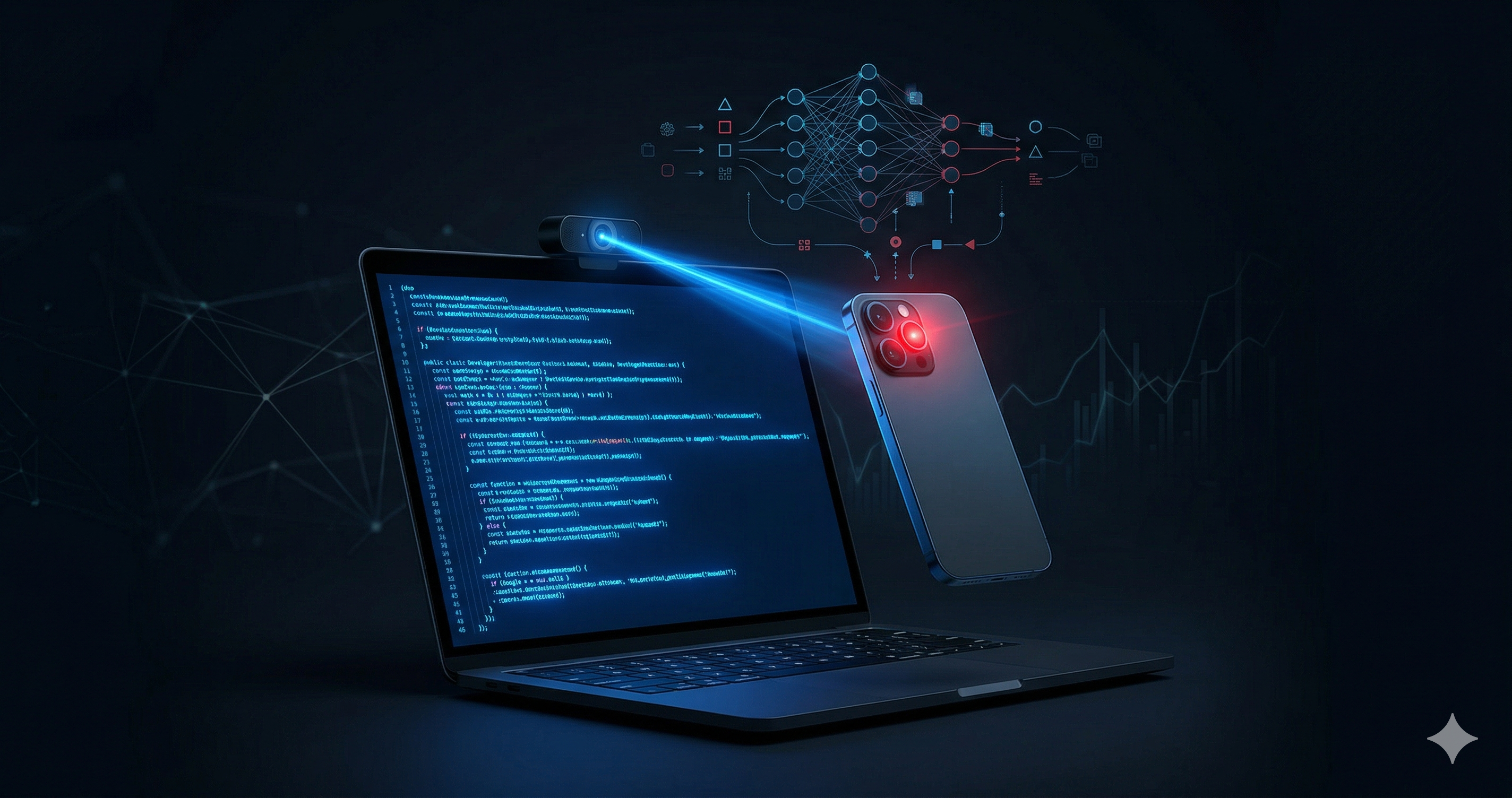
Screen DLP operates at the physical layer that all existing DLP tools ignore. Using the device's existing webcam and on-device AI processing, it detects smartphones positioned to capture screen content and responds before the image is taken — blurring or locking the screen in real time.
What This Means for Enterprise Security Strategy
Organizations building their data protection strategy for the LLM era need to account for this new reality:
- AI DLP controls that monitor what employees type or paste into AI tools are necessary but not sufficient
- The screen photography workaround is already in use, and its prevalence will increase as AI tools become more capable and more embedded in daily workflows
- No existing DLP tool addresses this vector — it requires a dedicated Screen DLP solution
- Regulatory frameworks (DORA, ISO 27001, HIPAA) are increasingly explicit about physical safeguards that cover this scenario
The LLM revolution woke up the DLP market after years of stagnation. But it also created a new attack surface that the market has not yet addressed. Screen DLP software is the missing layer — protecting the physical screen that digital tools cannot see.